Introducing Driver Profiles — every 2026 grid driver, one click away
A new page on In the Marbles breaks down all 20 drivers on the 2026 grid — form, stats, and a radar chart that shows what each driver is actually good at.
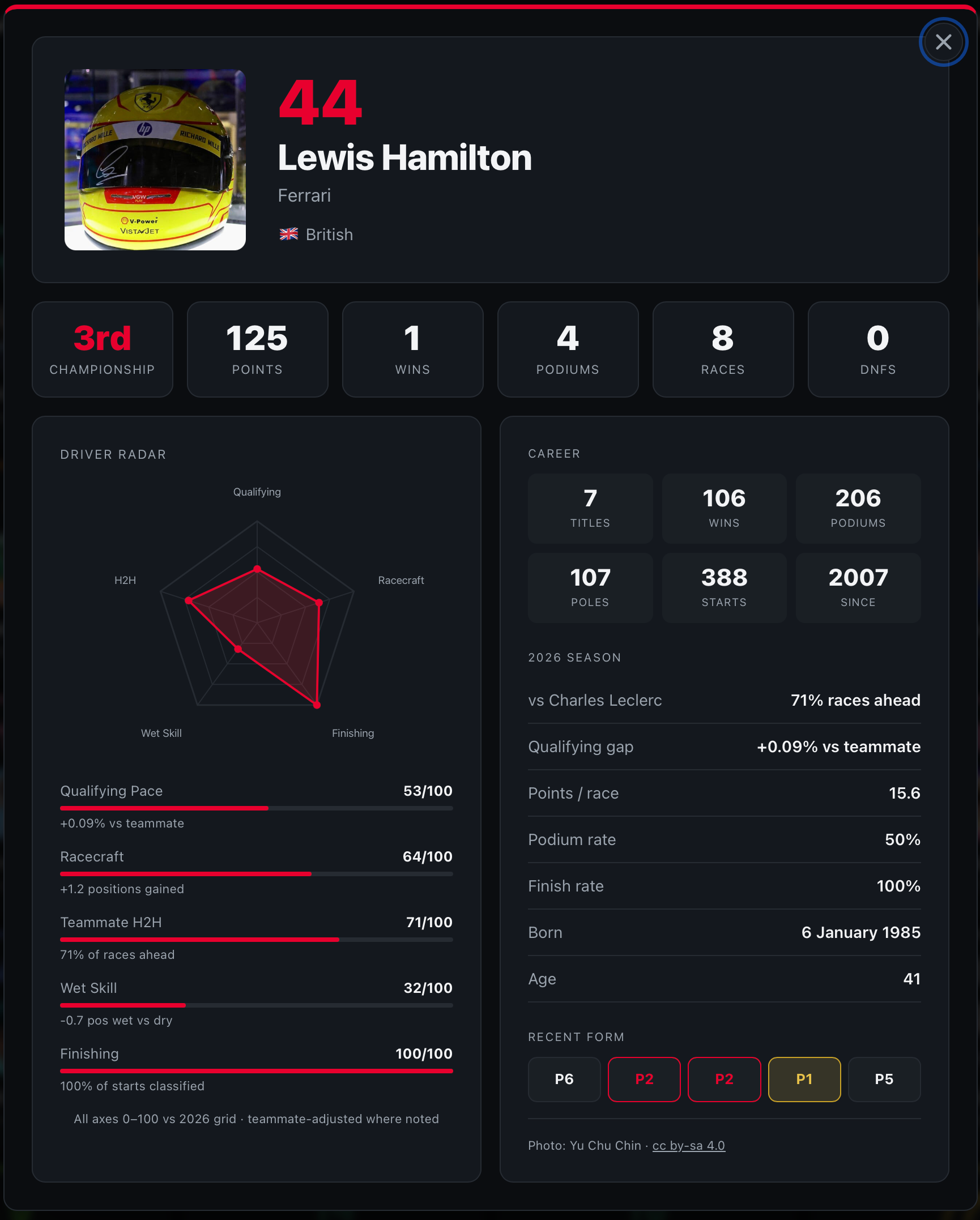
We just shipped Driver Profiles, a new page on In the Marbles that gives you a full breakdown of every driver on the 2026 grid — not just their points total, but how they're getting there.
What's on the page
Land on inthemarbles.com/drivers and you get a grid of all 22 drivers, sorted by championship order, each card carrying their number, headshot, and team colour. Click any driver and a full profile opens:
- Hero header — photo, number, team, and nationality at a glance
- Season snapshot — championship position, points, wins, podiums, races, and DNFs
- Driver Radar — a five-axis radar chart scoring Qualifying Pace, Racecraft, Finishing, Wet Skill, and Head-to-Head record, each on a 0–100 scale so you can compare wildly different drivers on the same footing
- The raw numbers behind the radar — qualifying gap to teammate, positions gained/lost in races, wet-vs-dry pace swing, percentage of races finished ahead of their teammate
- Career totals — titles, wins, podiums, poles, starts, and debut year
- Recent form — the last few races as colour-coded chips (gold for wins, accent colour for podiums, faded for DNFs)
Every profile also has its own shareable URL (e.g. /drivers#VER), so you can link straight to a specific driver instead of the page in general.
Why the radar chart matters
Points standings tell you where a driver is, not why. Two drivers can sit next to each other in the championship for completely different reasons — one might be out-qualifying the field and losing it in the race, another might be a mid-pack qualifier who's a menace at overtaking. The radar makes that visible in a shape rather than a spreadsheet: a lopsided radar towards "Wet Skill" and "Racecraft" but weak on "Qualifying" tells a very different story than a radar that's strong everywhere. It's also teammate-adjusted where relevant, since raw pace numbers mean little without a same-car benchmark.
Use cases
- Settling an argument — "is X actually better than Y right now, or just in a better car?" Pull up both radars side by side.
- Pre-race prep — check a driver's wet-weather number before a forecast-uncertain Sunday, or their recent form chips to see if they're building momentum or fading.
- Fantasy/prediction leagues — the finishing-rate and podium-rate numbers are a faster gut-check than digging through full results tables.
- New-fan onboarding — someone who just started watching F1 can click into a driver and get the full picture (team, nationality, career stats, current form) in one place, without needing outside context.
- Mid-season storylines — teammate H2H and qualifying-gap numbers are exactly the stat pairs pundits cite when a teammate battle heats up.
How it stays current
The page isn't hand-updated. An automated workflow pulls fresh profile data every Monday morning from our own F1 stats engine and pushes it straight into the page — so radars, stats, and form chips reflect the previous race weekend without anyone touching Ghost.